Category: Earth Resistance Meters

Earth Resistance Meters

Earth resistance meters test the resistance of soil to the passage of electric current to determine the adequacy of the grounding of an electrical system.   This is an indispensable aspect of a safe, properly functioning electrical system.

  • Earth Resistance and Soil Resistivity Meter MRU-12

    Earth Resistance and Soil Resistivity Meter | MRU-12

    Earth Resistance and Soil Resistivity Meter  - Overview

    The MRU-12 is a simple meter that allows you to measure grounding by the use of the technical method (3-pole and 4-wire) and soil resistivity by the Wenner and Schlumberger methods. The instrument is easy to handle, resistive to interference, and highly accurate. It is a basic device that allows for checking the quality of the grounding system on the basis of the received measurement result. It is ergonomically shaped, durable and has firm housing. It also has a large, clear display. This instrument is ideal to use in the field and most working environments. The device is simple to operate and intuitive. Suitable for electrical installation contractors, technicians, and professionals dealing with grounding measurements.

    Measurement methods

    • 3-pole and 4-wire method – measurement of earthing systems using auxiliary probes
    • 2-pole method
    • Earth resistivity – Wenner and Schlumberger method

    Earth Resistance and Soil Resistivity Meter  - Features

    • Resistance of auxiliary electrodes RH and RS
    • Measurement of interference voltage to 100 V
    • Indication of battery state
    • Selection of maximum measuring voltage (25 V and 50 V)
    • Auto-OFF function
    • In ground resistivity measurements, distances between electrodes can be input in meters (m) or feet (ft)
    • Memory of 990 measurement results (10 banks of 99 cells each)
  • Universal Earth Resistance and Resistivity Meter MRU-30

    Universal Earth Resistance and Resistivity Meter | MRU-30

    R21,285.00 ex vat

    Universal Earth Resistance and Resistivity Meter - Overview

    This compact earth resistance and soil resistivity meter enables efficient and easy earth resistance measurement. The MRU-30 meter is surprisingly versatile in nature. It can be used to perform single earthing measurements as well as multiple earthing measurements using additional clamps or electrodes. Additional capabilities include measurement of soil resistivity using the Wenner method, as well as verification of the continuity of equalising connections and protective conductors. Another advantage is the clear transmission of information, which alerts the user to possible dangers or detected irregularities. Information appears on the screen both before and after the test. Applications include measuring single and multiple earthings using auxiliary electrodes and/or clamps, ground resistivity (Wenner method), as well as verifying the continuity of equipotential bondings and protective conductors. It has a high immunity to interference, allowing it to be used even in difficult conditions. It is simple and intuitive to operate, making the measurements easier and faster. The meter has internal memory. The measurement results can be transmitted to a computer for data processing and preparation of documentation from the grounding tests.

    Universal Earth Resistance and Resistivity Meter -  Features

    • Measurement of auxiliary electrode resistances RS and RH
    • Measurement of interference voltage
    • Measurement in the presence of interference voltages in networks with frequencies of 50 Hz and 60 Hz
    • Selection of maximum measurement voltage (25 V and 50 V)
    • In ground resistivity measurements, distances between electrodes can be input in meters (m) or feet (ft)

    Measurement methods

    • 3-pole and 4-wire method – measurement of earthing systems using auxiliary probes
    • 3-pole method with clamp – measurement of earthing systems with multiple earth electrodes
    • Two-clamp method – measurement of earthing system when the auxiliary probes cannot be used
    • Earth resistivity – Wenner method
    • Resistance of earth connection and equipotential bonding measured using current ≥200 mA with auto-zero function – meets the requirements of EN 61557-4
  • Earth Resistance Meter MRU-10

    Earth Resistance Meter MRU-10

    R11,733.00 ex vat

    Safety Rating Cat IV at 150V labelIngress protection IP67 label

    Earth Resistance Meter - Overview

    The Sonel MRU-10 is a simple meter that allows you to measure earthing resistance using technical methods.  It also measures grounding resistance using the pole method. The instruments are easy to handle, intuitive, resistive to interference, and accurate. This unit checks the quality of the grounding system based on the received measurement result. The device is an excellent choice for electrical technicians, installation contractors and professionals dealing with grounding measurements. This Earth Resistance meter is durable with firm housing and has a big and clear display with an ergonomic design. Ideal to use both in the field and in most working environments.

    Earth Resistance Meter - Features

    • Measure earthing resistance using auxiliary electrodes method 2-pole and 3-pole
    • Measurement of resistance of auxiliary electrodes RS and RH
    • Measurement in the presence of interference voltage in the power network with frequency 50 Hz and 60 Hz
    • Selection of maximum measuring voltage (25 V and 50 V)
    • Measurement category: CAT IV 150 V  acc. to EN 61010-1
    • Protection class acc. to EN 60529: IP67
    • Indication of battery state
    • LCD display: segment, backlit,
    • Number of measurements (RE3P) carried out of set of batteries: > 3000


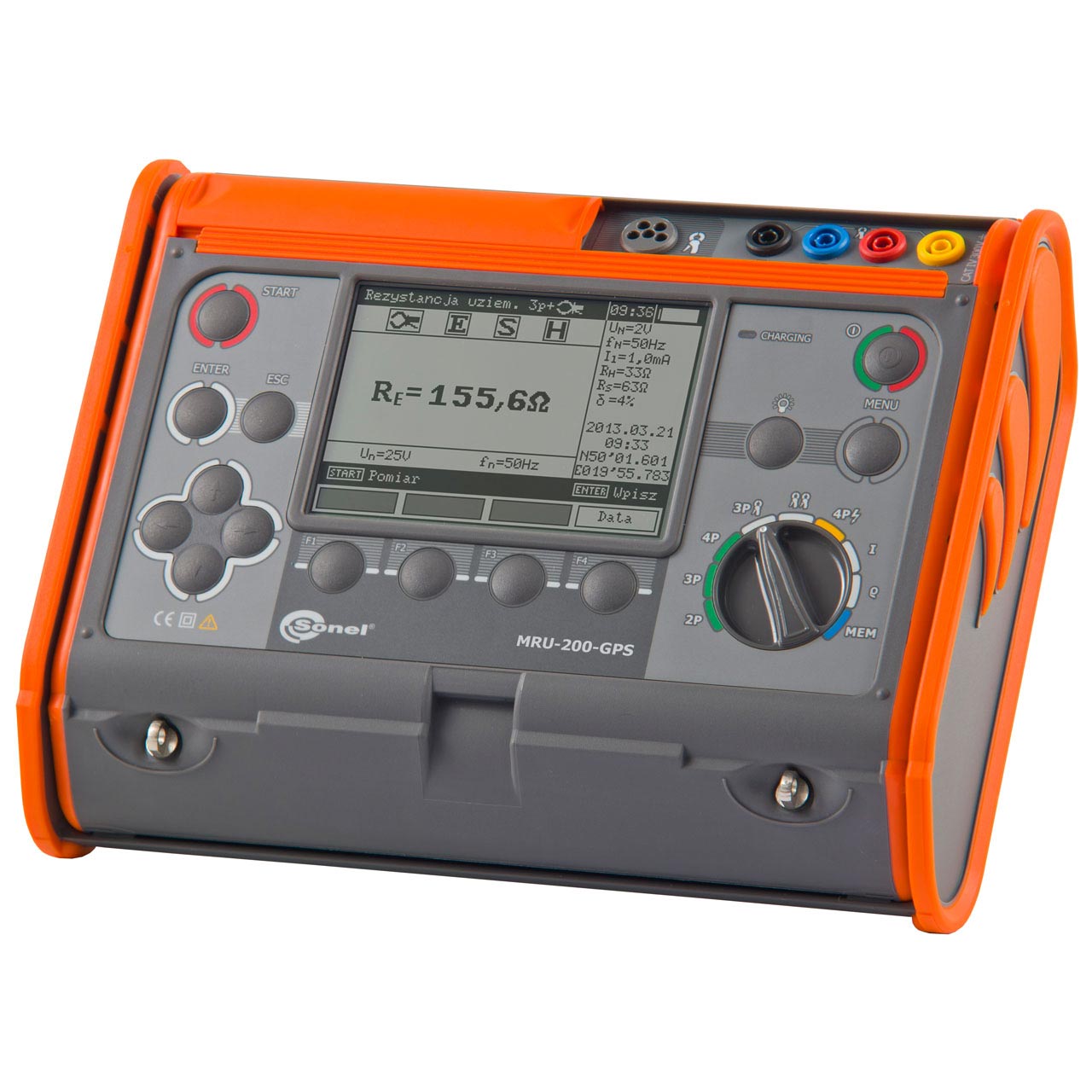
  • Earth Resistance Meter MRU-200 GPS

    Earth Resistance Meter | MRU-200 GPS

    Price range: R49,225.00 through R53,851.00 ex vat

    Safety Rating Cat IV at 300V label Safety Rating Cat III at 600V label Bluetooth Enabled label GPS

    Earth Resistance Meter - Overview

    The MRU-200 earth resistance meter is unique in the market as it uses all measurement methods to get earth resistance.  Making sure the ground system has a low earth ground resistance when initially installed is a very important safety check. Making sure the low resistance is maintained is just as important. Resistance of the grounding system might increase when the ground rods are corroded. Over time, soil with high moisture, salt content and high temperatures will corrode connections.  It is therefore recommended that the earthing be checked periodically to make sure there is not a big increase in resistance.

    Earth Resistance Meter - Features

    • earth resistance measurement with 2-pole, 3-pole,4-pole method
    • two clamps earth resistance measurement without auxiliary test probes
    • impulse earth impedance measurement, three kinds of measuring impulse 4/10μs, 8/20μs, 10/350μs
    • earth resistance measurement without disconnecting measured earths (using clamp)
    • continuity measurement
    • leakage current measurement
    • optional built-in GPS
    • GPS coordinates of the measurement are stored in meter memory (with GPS model)
    • measurement of resistance of auxiliary electrodes RS and RH
    • measurement of interference voltage
    • measurement of interference frequency
    • measurement in the presence of interference voltage in the power network
    • with frequency 16 2/3 Hz, 50 Hz, 60 Hz and 400 Hz (with automatic selection of proper frequency of measuring signal)
    • selection of maximum measuring voltage (25 V and 50 V)
    • introducing the distance between the electrodes for the resistivity in meters (m) and feet (ft)
    • memory of 990 measurements (10 banks of 99 cells each)
    • calibration of clamp used
    • real-time clock (RTC)
    • data transmission to the computer USB and Bluetooth*
    • indication of battery state

    https://www.youtube.com/watch?v=vKKubPxECV8


  • Electrical Installation Meter with Power Analyzer | MPI-540

    Safety Rating CAT III at 500V LabelSafety Rating Cat IV at 300V labelLi-Ion Battery labelIP51 LabelBluetooth labelWiFi label

    Electrical Installation  Meter - Overview

    The MPI-540 meter is designed for checking the safety of industrial and domestic electrical installations. The user has the option to register the parameters of electrical networks located at these facilities. This allows for the measurement of the parameters for protection against electric shock using a single universal device while verifying the quality of electricity. The Auto mode allows significant automation of measurements of the meter and makes it possible to test the functioning of residual current circuit breakers, as well as in pre-programmed measuring sequences, which can be extended with their own sequences. Automatic measurement of insulation resistance of 3-, 4- and 5-wire conductors is possible by using an additional AUTO ISO-1000C adapter.