

Acoustic Imagers
Acoustic Imagers are advanced diagnostic instruments designed to visualise sound waves, enabling industrial maintenance teams to detect, locate, and analyse acoustic emissions in real time. By combining an array of highly sensitive microphones with a digital optical camera, these devices overlay acoustic data onto a live visual image, effectively making invisible sound sources visible on screen. This is extremely useful in industrial applications to detect leaks of compressed agents. It is also used to detect partial discharges in the power utility industry.
Why Acoustic Imagers matter
The primary reasons to measure acoustic emissions using acoustic imagers are predictive maintenance, safety enhancement, and energy efficiency. In industrial facilities, compressed air leaks, vacuum leaks, gas leaks, and high-voltage electrical partial discharges (such as corona, tracking, and arcing) produce distinct ultrasonic signatures. These sound signals often occur long before physical damage or overheating becomes visible. Identifying compressed air and gas leaks allows plant managers to eliminate energy waste, reduce operating costs, and decrease carbon emissions. Early detection of electrical partial discharge prevents catastrophic equipment failures, costly unplanned downtime, and severe safety hazards like electrical fires or arc flashes.
Acoustic Imager Technology
Modern acoustic imagers rely on Micro-Electro-Mechanical Systems (MEMS) microphone arrays combined with real-time Digital Signal Processing (DSP). As sound waves hit the microphone grid, advanced phase-array algorithms calculate the tiny time delays between microphones to determine the exact direction and origin of the sound source. The device filters out background industrial noise, isolating specific high-frequency bands. This processed acoustic map is displayed in colour-coded heatmaps over a standard visual photo or video, allowing technicians to inspect large areas quickly and safely from a distance.
Acoustic Imagers
Acoustic Imagers are advanced diagnostic instruments designed to visualise sound waves, enabling industrial maintenance teams to detect, locate, and analyse acoustic emissions in real time. By combining an array of highly sensitive microphones with a digital optical camera, these devices overlay acoustic data onto a live visual image, effectively making invisible sound sources visible on screen. This is extremely useful in industrial applications to detect leaks of compressed agents. It is also used to detect partial discharges in the power utility industry.
Products by Category
-

Industrial Acoustic Imager | KUS-200
R296,893.00 ex vat -
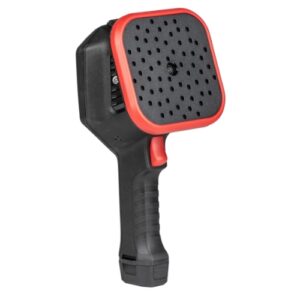
Leakage and Partial Discharge Acoustic Imager | KUS-100
R227,887.00 ex vat